Understanding Society’s Insights report for this year sets out what research using our data tells us about children’s development and young people’s life chances. We launched the report at an event in February, and this blog post summarises some of the evidence presented, including related evidence using other data, and links to the presentations.
Edward Melhuish, Professor of Human Development at the University of Oxford, and Birkbeck, University of London, opened the event with a keynote presentation, Lessons from research for Policy Planning of Early Childhood Education and Care (ECEC).
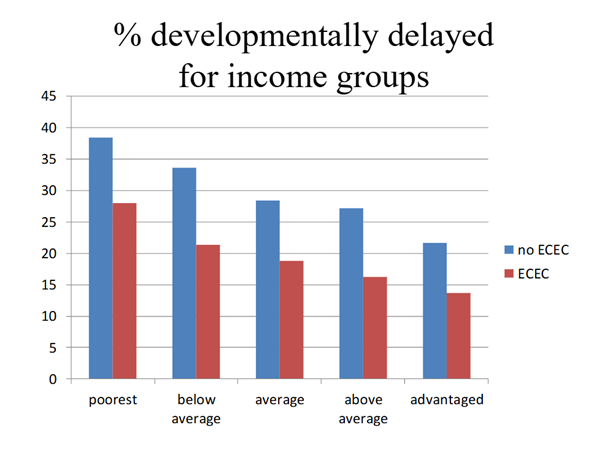
He looked at links between socioeconomic status and development, saying that OECD figures show 22% of children entering school with developmental problems. Disadvantaged children have five times more low literacy than their advantaged counterparts, and one in three disadvantaged children start school with poor language skills. This has knock-on effects, because disadvantaged groups are at greater risk of social, emotional, and behavioural problems; attention, cognitive and language problems; and poor health. These, in turn, affect literacy, numeracy, social skills, employability, health, adjustment and criminality.
If these problems are already affecting children’s lives by the time they’re starting school, it’s only logical to focus on what can be achieved before then. Early childhood is incredibly important for brain development – with 60% of nutrition in the first year of life being used by the brain. Edward pointed out that we are born with 100 billion neurons, which are all we get. Our synapses, though, increase – to the tune of 700 per second in the early years. By the age of 3, 80% of our synaptic connections have already been made – and if a pathway is used, it’s kept, but those which aren’t are ‘pruned’.
This period is vital, then, and especially for developing language skills. At the age of 1, children are primed to learn any language. By 3, the connections are in place for the cultural language they are learning – and the third year is crucial, because connections are set by then. Language underpins cognitive, educational and social development – and a child with poor language skills at the age of 3 will be at risk in these three areas unless there is some intervention.
To see what needs to be done, we need to consider two environments: the home, and potential development in childcare settings.
Edward described parents, carers, and childcare workers as the architects of children’s brains, because the more words children hear, and the more conversations they are part of, the more their brains develop. He mentioned the work of Betty Hart and Todd Risley, who introduced the idea of a word gap. Compared to the poorest families, children in the wealthiest families hear around 30 million more words spoken to them by the age of 4.
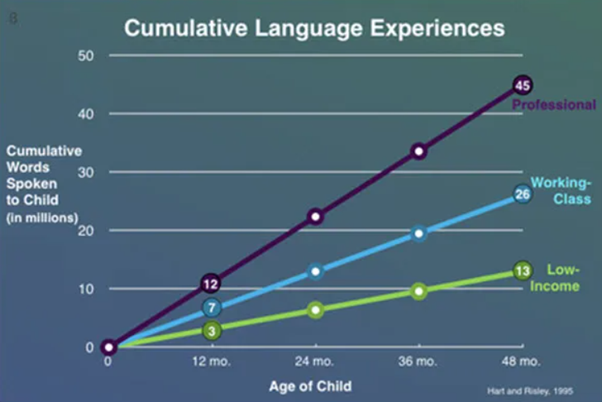
Given how early language development affects later life, this naturally means that advantage and disadvantage are passed on. Language is a foundation for education generally, and critical for reading and maths – so when disadvantaged children enter school with poor language skills, they are immediately at a significant educational disadvantage.
Another factor in early childhood which affects long-term development is self-regulation, a child’s ability to regulate their own emotions and behaviour – measured by things like concentration, perseverance, and thinking before acting. We start learning these abilities early in life, and research has shown that self-regulation at 5 can predict health, wealth, and criminality at 30 – in fact, it’s a stronger predictor than social class and IQ.
Also, throughout childhood and adolescence, we build cognitive skills such as memory, flexible thinking, and self-control. Parents are important here, of course, but good quality early childhood education and care improves most aspects of development, and the most important are language and self-regulation. The benefits of early childhood education and care are greatest for disadvantaged children.
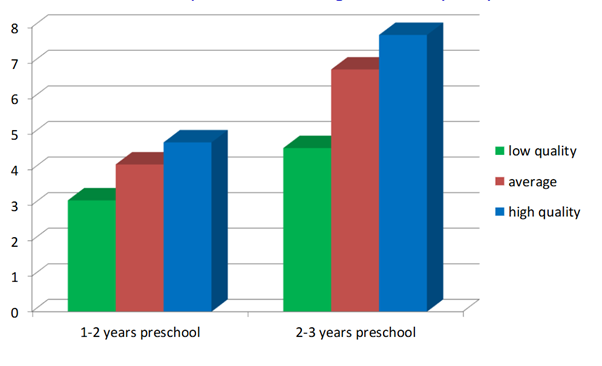
Research for the Department for Education shows the advantage of pre-school for literacy. The Effective Pre-school, Primary and Secondary Education Project (EPPSE) found that children who attended high quality pre-school for 2-3 years were nearly 8 months ahead in their literacy development compared to children who had not attended pre-school.
This research found that part-time early childhood education and care has the same benefit as full-time, and its effects persist until adulthood. It can also protect a child from the effects of an underperforming primary school – and even reduce a child’s SEND (special educational needs and disabilities) needs at school age. Also, given how crucial the early years are, intervention at this stage is more effective (and cheaper) than at primary school stage.
To be effective, a pre-school needs to focus on factors such as:
The home environment has a great impact, and children can be helped to develop through reading with the child, drawing/painting, playing with letters, and singing nursery songs. But both environments are important. One fact which particularly underlines this is that preschool and primary school have the same developmental effect – but preschool achieves this in just 18 months, while primary school lasts six years.
Another piece of research which Melhuish co-authored examined Sure Start centres, comparing areas with a centre to those without. Of 14 outcomes, seven showed a significant difference between Sure Start areas and comparison areas:
There was a similar pattern of results at 3, 5 and 7 years of age – a clear Sure Start effect.
Overall, Edward said, early childhood education is “part of the infrastructure for a successful society”.
In the afternoon, Mark Russell, Chief Executive of The Children’s Society gave a perspective on reducing social inequalities among children and young people. In it, he said there is a crisis in childhood, and – asking the audience to imagine a dashboard – said all the lights are currently flashing red.
The Children’s Society uses Understanding Society each year for its Good Childhood Report, and a review of its research programme has shown that each report since 2017 “has outlined a significant decline in children’s happiness with their life as a whole compared to the start of the Understanding Society study.” Although the majority of children and young people appear to lead relatively happy lives, it says, “an important proportion of children and young people have low subjective wellbeing (or low life satisfaction)”.
Mark said the top concern among children had moved from the environment to the cost of living, and that life is “just too difficult for too many children” now, including not having a holiday. He added that many children are unhappy with schools, not with school work or teachers.
Perhaps his most important point was that there was a need “to move away from sticking plaster policy” and ask how we can “heal the wounds”. He identified six things which were needed for change:
In the panel discussion at the end of the day (see below), Mark also raised the issue of parents shaping the home environment. Less stable families and less prosperous communities face disadvantages in this regard – as do families with an absent parent (often the father). Inevitably, disadvantaged families are also those where children may find it challenging to find an alternative role model, such as a relative, youth worker, or teacher – and this compounds their disadvantage.
There was a range of presentations throughout the day, including:
The day concluded with a panel discussion on the theme of delivering priorities over the current parliament and beyond, with:
Jasmine discussed Southwark’s Schools Inclusion Charter, which aims for 100% inclusion by treating exclusion as signal of unmet need rather than punishment for behaviour. She looked at cross-cutting issues such as child poverty, school meals, youth mental health services, and play provision – and how local authorities can coordinate early intervention despite fiscal constraints. She also pointed out the need for alignment between national policy ambitions and local delivery capacity, and said early interventions work best for the most deprived neighbourhoods.
Lydia explored the tension in current early years policy: while the entitlement to 30 hours of free childcare supports working families, eligibility criteria based on work status and income exclude disadvantaged children who would benefit the most from good quality early education. She emphasised the fact that the disadvantage gap starts before school, and pointed out how important it is that parent-led programmes reach isolated families. Coram says the entitlement to free early years education should be universal, because only offering it to working parents is “greatly regressive”, and perpetuates inequality. The organisation also feels that a target of only 75% of children achieving something by the age of 5 is not right.
Kadra discussed the Children and Young People’s Mental Health Coalition’s advocacy for whole-school approaches to mental health, building on the government’s commitment to specialist mental health support in schools and FE colleges by 2029. She addressed the implementation of mental health support teams, the importance of embedding wellbeing into school culture rather than treating it as separate intervention, and working with teachers who increasingly identify mental health needs. The Centre says that intervention for mental health is happening too late, and that community-based intervention is, in any case, significantly cheaper than clinical intervention.
Barry brought evidence from Youth Futures Foundation on youth employment, focusing on marginalised young people. He discussed the scarring effects of being NEET (not in education, employment, or training), barriers faced by care leavers and disadvantaged youth in accessing good jobs, and the relationship between mental health and employment outcomes. Poorer mental health in this cohort wasn’t being driven by underlying functional factors, such as risky behaviours (including excessive drinking and smoking, although evidence on drug use remains to be examined). He pointed out that the level of young people who are NEET is now broadly stable – and that it is driven by both demand and supply side factors such as lack of qualifications, neurodiversity, and declining job vacancies – particularly in retail and entry level positions.
Overall, our Insights report says there is a compelling case that we are a facing a major generational challenge with long-term consequences – and it makes far reaching, and sometimes challenging, policy recommendations as a result. But the task ahead is not simple. Our report, and the speakers, pointed to the need for concerted preventive action across a broad front, and especially greater investment in Early Childhood and Education for the most disadvantaged children. Tackling inequality of opportunity, and significantly weakening the tie to destiny, is not a matter of knowing what works, and implementing it. It requires us to see what is working, where, and for whom – to understand audience, engagement and place. We can’t build opportunities and expect children and families to simply walk through the door.
Authors