
Many of us have complained about the long, wet winter we had in the UK this year, but can weather conditions influence us more deeply?
Previous research has looked at whether our assessments of our financial state are linked to our mental and physical health — and policymakers are increasingly interested in wellbeing alongside GDP. To the best of our knowledge, though, no other study before ours has estimated the relationship between weather conditions and how people feel about their lives and finances.
The data we used
We used data from both the British Household Panel Survey (BHPS) and its successor, Understanding Society. We looked at responses from people aged 16 and over in Waves 1-18 of BHPS (1991-2008) and Waves 1-9 of Understanding Society (2009-18). This gave us a combined total of over 400,000 observations spanning three decades. We also collected weather data from 32 weather stations in Great Britain, and used people’s Local Authority District to work out which one was closest to them.
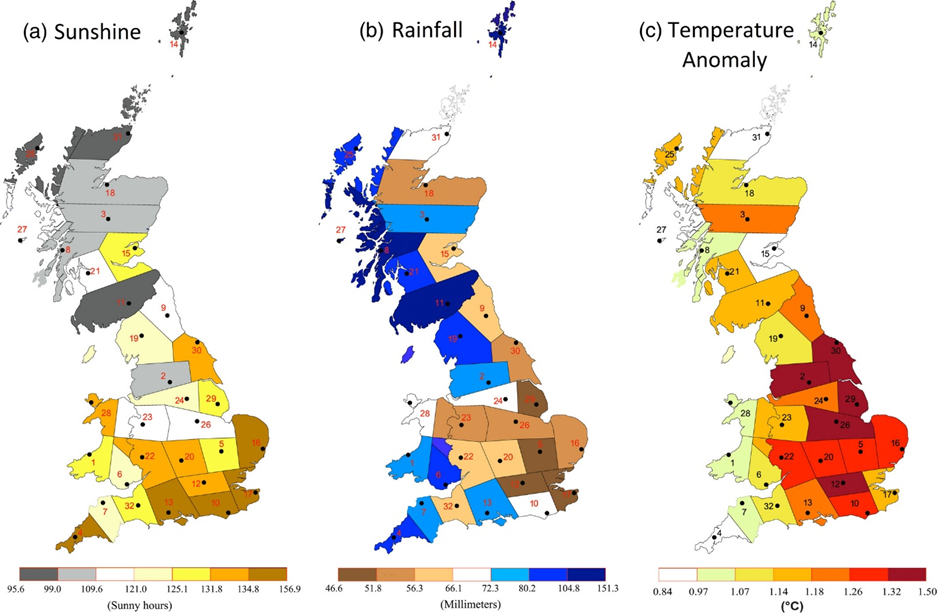
The maps here show average weather conditions in areas surrounding the weather stations, with the map using the average distance between them to form approximate boundaries for each area. In the third map, ‘temperature anomalies’ are deviations from historical average temperatures that reflect climate change. They’re calculated by taking the monthly mean temperature per year from 1991 to 2018 and subtracting the 40-year average monthly temperature from 1950 to 1990.
We looked at answers to questions about:
- how people feel they’re managing financially — with answers on a 1-5 scale from ‘finding it very difficult’ to ‘living comfortably’
- how they expect to be doing the following year — with three answers: ‘worse off than now’, ‘about the same’, and ‘better off’
- job satisfaction, life satisfaction, household income satisfaction, and health satisfaction — each answered on a seven-point scale from ‘completely dissatisfied’ to ‘completely satisfied’
- mental distress using the General Health Questionnaire, which asks 12 questions about subjects such as ability to sleep and concentrate, feeling under strain, and enjoying everyday activities.
Of course, people’s personalities and innate abilities can affect how they respond. Pessimists might consistently report lower levels of subjective wellbeing, for example, and people with more dynamic personalities or innate ability may be more mobile, and able to live somewhere with sunnier weather. Because BHPS and Understanding Society follow people over time, though, we can adjust for these characteristics. We also controlled for factors such as household income, age, employment or economic inactivity, holding university qualifications (or not), and having children.
What we found
Our findings show that weather has a meaningful impact on how people feel about their lives and finances. A sharp rise in monthly sunshine — from around 107 to 290 hours — increases how likely someone is to report a more optimistic outlook on their future finances by 10.5%. By contrast, heavier rainfall is associated with lower wellbeing: an increase in average daily rainfall from 1.7 mm to 4.7 mm reduces reported life, income, and health satisfaction by roughly 6%.
Temperature anomalies — the deviations from historical average temperatures that reflect climate change — also have strong negative effects. When temperature anomalies rise from 0.8°C to 2.1°C, the probability of people reporting that they feel positive about their finances now, and expect to in the future, falls by about 9-10%. Life, income, and health satisfaction decline by 7-9%.
We also found that daily weather observations in general were not significantly related to self-reported wellbeing responses, but 30-day averaged weather measures did — so it seems that short-lived weather patterns are not related to wellbeing, while persistent weather conditions are.
It’s important to emphasise that we can’t be certain about causality, but we have identified strong links between weather and wellbeing. And we tested our results to make sure they were not affected by factors such as the month people were interviewed in, and by economic factors in their region. We also took account of people who moved from one region to another, in case they did so in search of better weather.
Economic impact and policy implications
The changes in wellbeing we identified translate into substantial economic impacts. Increased sunshine is associated with monthly wellbeing gains equivalent to £91 for current finances, and £140 for expected finances. By contrast, temperature anomalies impose large welfare losses. Given an average monthly household income of £2,654, the estimated wellbeing cost of temperature anomalies — around £405 per month for expected financial wellbeing — amounts to over 15% of household income.
This suggests that climate change is already imposing a significant hidden cost on households, not in bills or wages, but through how people feel, cope, and make decisions. As our climate continues to deviate from previous norms, it isn’t just damaging infrastructure and ecosystems, it’s also changing how we think about our future – which very much supports the idea that we should be taking action to tackle it.
Find out more about research on how people respond to climate science, and which policies might work in our long-read blog, Climate change: what do we think, and what are we doing?
Authors

Georgios Marios Chrysanthou
Georgios Marios Chrysanthou is a Lecturer in the School of Business at the University of Dundee

Panagiotis Tzouvanas
Panagiotis Tzouvanas is a Senior Lecturer in Economics & Finance at the University of Portsmouth