All UK workers who have worked for an employer for 26 weeks or more have the right to request flexible working arrangements (FWA). This could be in the form of flexible hours or home working. Employers are legally bound to consider requests, but have the right to refuse them if there is a business case to do so.
The UK has relatively high levels of flexible or home working, even before the coronavirus pandemic, with pre-covid figures of 10% of fathers and 12% of mothers working flexibly and 1% of fathers and 11% of mothers working term-time only. Although there is a growing demand for FWAs, there is a difference in take-up of flexible working between men and women. Research in this area has focused on how women use FWAs and researchers from King’s College London, UCL and University of East Anglia wanted to see what might be stopping men applying for flexible working.
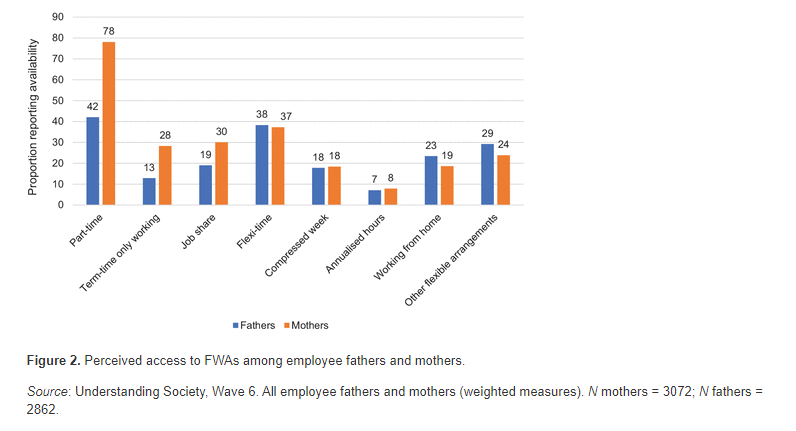
They used Understanding Society data from 2015, where questions were specifcally asked about flexible working plans, to look at how men perceive FWAs. They found that 30% of fathers and 10% of mothers reported that no form of FWA was available to them. If flexible working was perceived to be available, part-time work was more commonly reported as available by mothers (78% of mothers and 42% of fathers). Job shares and term-time working were also more likely to be reported as available by mothers.
When the researchers look specifically at fathers they found that the perception that hours reduction is unavailable is more common among lower educated fathers and those in supervisory or technical occupations. Fathers in the private sector and in male-dominated industries were also more likely to perceive that they cannot reduce their hours. Being in a workplace with a trade union presence also makes a difference, with fathers in workplaces with no union presence more likely to see reduction of their hours as unavailable. Working in the public sector makes it more likely that men perceive that FWAs are available. This could be because there is less stigma attached to flexible working, but also greater job security and promotion of family-friendly working practices.
When looking at the policy implications for encourging fathers to apply for FWAs, the researchers say, “Given the greater potential of hours reduction to be used for childcare rather than career development purposes, UK work–family policy efforts could focus on increasing awareness and reducing stigma around hours reduction for both parents when children are young, potentially taking inspiration from parents’ guarantees to shorter working days in Nordic countries. Changing perceptions around hours reduction could form part of broader efforts to tackle the long-hours work culture and close the gender pay gap as well as ensuring that parents can fulfil shared parenting aspirations.”
Read the research paper Fathers’ Perceptions of the Availibility of Flexible Working Arrangements: Evidence from the UK.
EmploymentFamily and households