This Wave 5 study tested ways of measuring perceptions about the economic returns to higher education, the costs involved, and experimentally tests the effects of information on actual decisions to attend university.
Respondents aged 16-21, and one of their parents, were asked questions about their expectations regarding the following: the likelihood of achieving A-levels, of applying to university for different subjects, of being accepted at university, expected costs, expectations of finding a job and of earnings conditional on having a university degree in a particular subject or conditional on having only a high school degree. This content is available at items e_oddsqual to e_earninfo, and e_kidstat to e_pearninfo on record e_indresp_ip.
In addition, half of the respondents were provided with information about the economic returns to higher education consisting of the distribution of wages among university graduates in various degree areas by gender. The other half of the sample did not receive any information. The controlling variable for this information treatment is e_ff_wageinfow5 on record e_hhsamp_ip:
Group 1 Wage information
Group 2 No wage information
The information treatment provided to respondents is shown in Figure 3, Average annual earnings by education, 2004-2011
Average annual earnings by education, 2004-2011
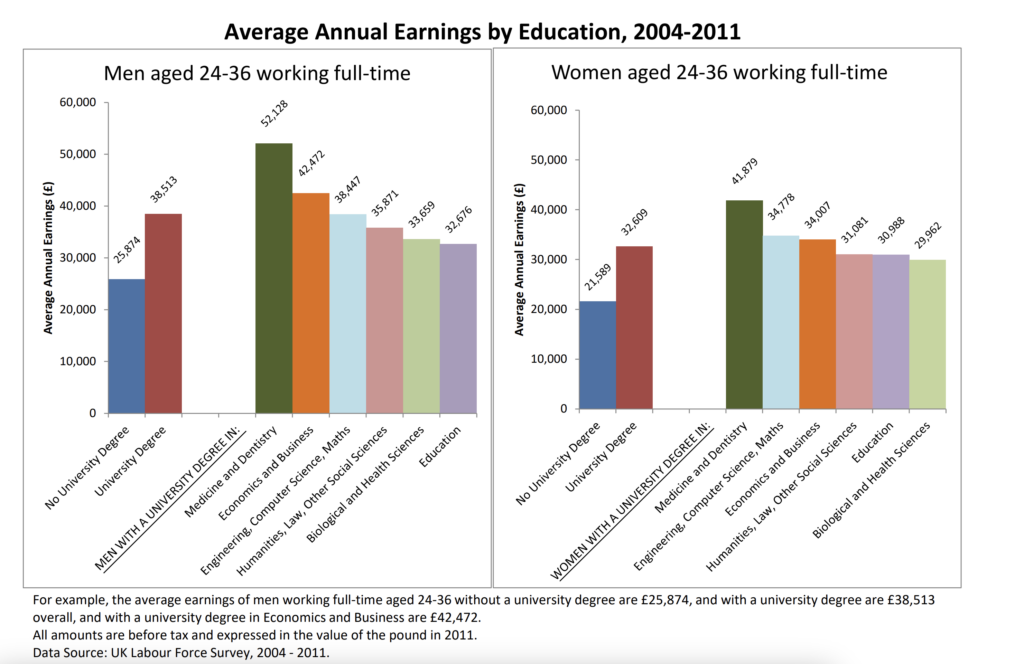
In Wave 8 this experiment was repeated. All responding adults aged 16-21 not in higher education were asked about the perceived costs and benefits of obtaining a higher education degree. Parents of children age 10-21 not in higher education were asked about their expectations for their child, vis., the costs and benefits of that child obtaining higher education. For parents, one child was selected about whom they were asked to report: the eldest co-resident child aged 16-21 not in higher education and if no such child then the eldest aged 10-15, and if no such child then they were not asked.
In Wave 9, respondents who answered the Wave 8 questions were asked the same questions again, but without an information treatment. Between waves 8 and 9, all respondents who received the information during the wave 8 interview were posted a copy of the same information.
A random half of all adults responding to these questions received information on earnings for men and women across a range of occupations. Randomisation was at the household level, meaning households within PSUs were randomly allocated to treatment.
Controlling variable: ff_wageinfow8
0 = no wage information
1 = wage information
In wave 9, there is no random allocation for this experiment. Fed forward indicator flags identify those who responded at Wave 8, and for parents, the child asked about.
In the survey the personal information relating to this youth pidp was pre-filled in the parental expectations module.
Fed forward indicators :
ff_yahechoiceip8
0 = Not asked young adult education expectations module
1 = Asked young adult education expectations module
ff_paredexpectip8
0 = Not asked parental education expectations module
1 = Asked parental education expectations module
ff_paredaboutip8
takes on the pidp of the child the parent was asked about in the wave 8 parental expectations module. If ff_paredexpectip8 =1
The contents is available in record i_indresp: hemakeappl, heapplstat, heage30, oddsqual, oddsapply, oddsschol, xptuition, xpborrow, unifin1, unifin1_new, unisub1, oddsemp1, oddsemp3, xpearn1, xpearn1dk, Xpearn4, Xpearn4dk, xpearn3, xpearn3dk, xpearn5, xpearn5dk, xpearng1, xpearng1dk, xpearng3, xpearng3dk, xploanpy, kidstat, katuni, pheage30, poddsqual, pheapplied, poddsapply, poddsschol, pxptuition, pxpborrow, pacborrow, punifin1, pacunifin, punisub1, poddsemp1, poddsemp3, pxpearn1, pxpearn1dk, pxpearn4, pxpearn4dk, pxpearn3, pxpearn3dk, pxpearn5, pxpearn5dk.